
API 661 Air fin coolers are mostly used to cool down processes that requires a huge amount of heat exchange. They are used mainly in the Oil & Gas and petrochemical industries but can also be found in power plants, mining and heavy industries. Air coolers offer a lot of advantages:
- The Cooling medium is air and is free (no need to cool water or have a secondary loop)
- Air is non-corrosive
- Can be installed on piperack or on the ground
- Low maintenance cost (compared to a cooling tower)
- Easy to assemble
Principal
The principle of operation is very simple:
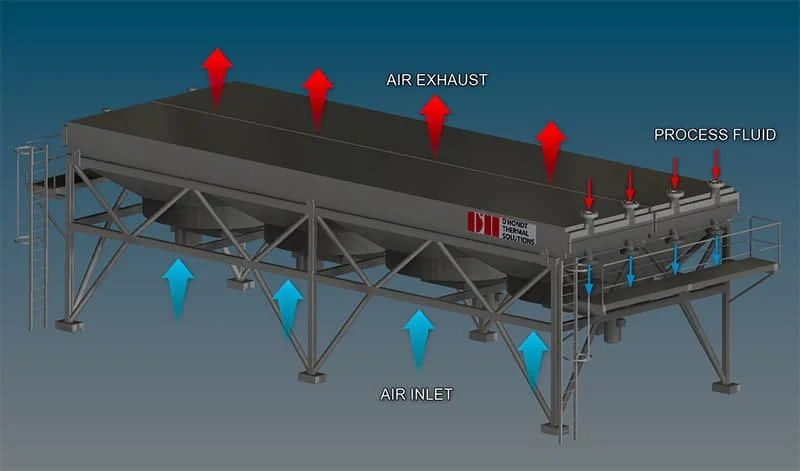
The process fluid is cooled while circulating inside finned tubes by the ambient air blown through the tube bundles by fans. The process fluid enters/exits the air coolers by respectively the inlet/outlet headers. The air coolers is made up of a bank of several finned tubes bundles in a “side by side” arrangement according to the overall heat output. The main benefit of using an air cooler is the elimination of an auxiliary water supply. Thus, air-cooled heat exchangers provide a lower environmental impact than shell and tube heat exchangers or cooling towers.
The air coolers are mainly composed of the following:
- Finned tubes bundles
- Motor & Fans
- Plenums
- Supporting steel structure
- Accessories
Configuration
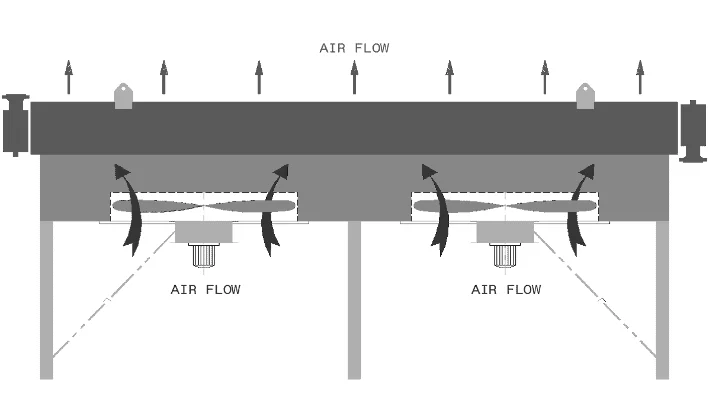
1. The air cooler is forced draft type:
This means that the fans are located below the bundles and the finned tube bundles are mounted on the top of a supporting steel structure. The fan rings air inlets (with/without inlet bell) are suspended to the plenums.
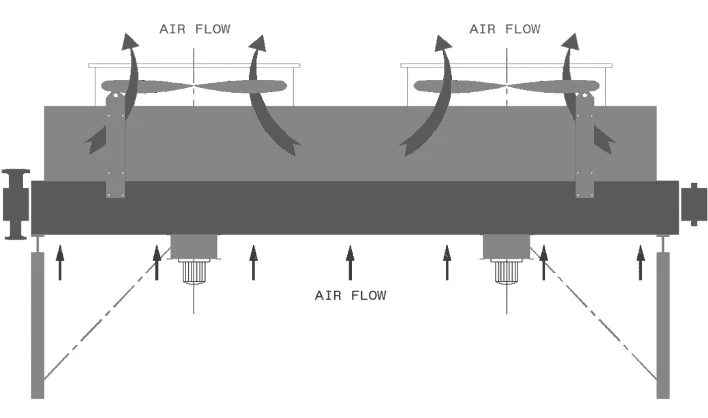
2. The air cooler is induced draft type:
This means that the fans are located above the bundles and the finned tube bundles are mounted on the top of a supporting steel structure. The fan rings air inlets (with/without inlet bell) are assembled above the plenums. The motors are below the bundles and the fan / motors connection is done with a shaft crossing the bundle.
Related Products

ECONOCOIL® is a very efficient and versatile light-duty plate-type heat exchanger. Its unique construction enables an economical choice.

Discover high-performance heat exchangers for HVAC and industrial systems. Designed for efficient heat transfer and durability.

Discover blast freezers for fast and efficient freezing. Ideal for food processing and cold storage with HFC, CO₂, and DX systems.

PLATECOIL® Heat Exchangers combine flexibility and functionality to deliver more efficient, economical and uniform heating and cooling to any application.

High-efficiency condensers and gas coolers for industrial and commercial refrigeration systems. Optimized for HFC and CO₂ applications.

Explore dry coolers and oil coolers for efficient, water-free cooling in industrial processes, data centers, and energy systems.

