
API 661 Air fin coolers are mostly used to cool down processes that requires a huge amount of heat exchange. They are used mainly in the Oil & Gas and petrochemical industries but can also be found in power plants, mining and heavy industries. Air coolers offer a lot of advantages:
- The Cooling medium is air and is free (no need to cool water or have a secondary loop)
- Air is non-corrosive
- Can be installed on piperack or on the ground
- Low maintenance cost (compared to a cooling tower)
- Easy to assemble
Principal
The principle of operation is very simple:
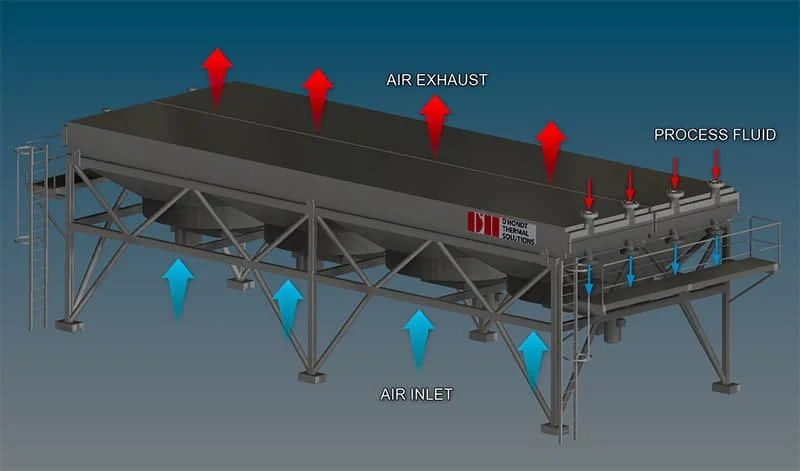
The process fluid is cooled while circulating inside finned tubes by the ambient air blown through the tube bundles by fans. The process fluid enters/exits the air coolers by respectively the inlet/outlet headers. The air coolers is made up of a bank of several finned tubes bundles in a “side by side” arrangement according to the overall heat output. The main benefit of using an air cooler is the elimination of an auxiliary water supply. Thus, air-cooled heat exchangers provide a lower environmental impact than shell and tube heat exchangers or cooling towers.
The air coolers are mainly composed of the following:
- Finned tubes bundles
- Motor & Fans
- Plenums
- Supporting steel structure
- Accessories
Configuration
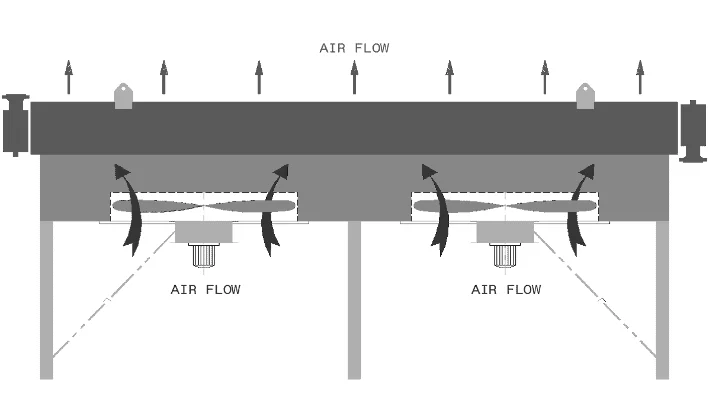
1. The air cooler is forced draft type:
This means that the fans are located below the bundles and the finned tube bundles are mounted on the top of a supporting steel structure. The fan rings air inlets (with/without inlet bell) are suspended to the plenums.
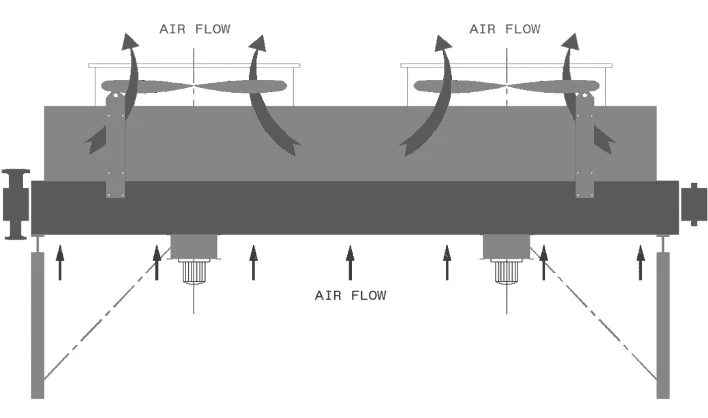
2. The air cooler is induced draft type:
This means that the fans are located above the bundles and the finned tube bundles are mounted on the top of a supporting steel structure. The fan rings air inlets (with/without inlet bell) are assembled above the plenums. The motors are below the bundles and the fan / motors connection is done with a shaft crossing the bundle.
Related Products

The MAXCHANGER all-welded plate heat exchanger offers higher performance, in less space, at a lower cost.

High-efficiency condensers and gas coolers for industrial and commercial refrigeration systems. Optimized for HFC and CO₂ applications.

Reduce energy consumption with adiabatic cooling systems. Ideal for efficient and sustainable industrial and commercial cooling.

Used to cool down processes that requires a huge amount of heat exchange. They are used mainly in the Oil & Gas and petrochemical industries but can also be found in power plants, mining and heavy industries.

Comprehensive collection of high-efficiency, energy-conserving gasketed plate heat exchangers. With wide variety of certifications & standards to meet your specific needs.

High-performance air cooling solutions engineered for cold storage, warehouses, and industrial refrigeration systems

